
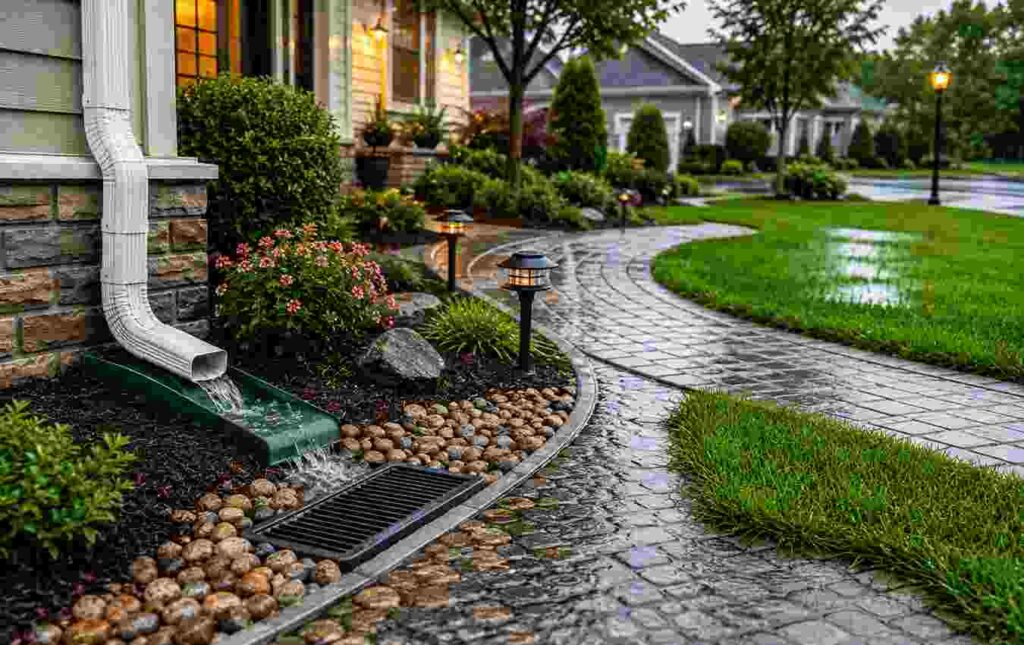
How Do I Redirect Rainwater Away From Front Yard and House?
The best way to redirect rainwater away from your front yard and house is to control where water flows before it reaches the foundation. Start by cleaning gutters and downspouts, extending downspout outlets away from the house, correcting low spots in the yard, improving soil grading, and installing a suitable drainage system such as a French drain, channel drain, catch basin, or underground downspout drain. The right solution depends on the amount of rainwater runoff, soil conditions, yard slope, and where the water can safely discharge. Heavy rainfall can quickly turn a front yard into a muddy, waterlogged area. If rainwater repeatedly collects near your home, it can damage landscaping, erode soil, create standing water, and potentially allow moisture to reach the foundation. Effective water runoff management helps protect both your yard and home while improving drainage after storms. Why Does Rainwater Collect in the Front Yard? Rainwater usually collects in a front yard because water has nowhere to drain efficiently. Several conditions can contribute to the problem: Poor grading or low areas in the lawn Compacted or clay-heavy soil Clogged gutters or downspouts Downspouts discharging too close to the foundation Improperly designed landscape beds Driveways or walkways directing water toward the house Insufficient drainage capacity during heavy storms Soil erosion caused by concentrated water flow Before choosing a drainage method, identify where the water originates, where it travels, and where it eventually collects. This simple assessment can prevent you from installing a drainage feature that only moves the problem to another part of the property. 9 Ways to Redirect Rainwater Away From Your House 1. Clean and Maintain Your Gutters Your gutter system is the first line of defense against roof runoff. Leaves, dirt, pine needles, and other debris can block water from flowing properly. Clean gutters regularly and check for sagging sections, damaged joints, or leaks. During heavy rain, observe whether water is flowing through the downspouts or spilling over the gutter edges. 2. Extend Downspouts Away From the Foundation One of the simplest ways to divert rainwater away from house foundations is to extend downspouts so they discharge farther into the yard. Downspout extensions can move concentrated roof runoff away from foundation walls. However, the outlet should not simply discharge into another low spot or toward a neighbor’s property. Water should be directed toward a safe drainage area where it can disperse or enter an appropriate drainage system. 3. Improve the Yard’s Grading The ground surrounding your house should generally slope away from the foundation rather than toward it. If the soil has settled or developed low areas, rainwater can flow back toward the house. Adding and reshaping soil can improve surface drainage, but grading should be planned carefully. Simply adding soil against the foundation can create other moisture problems if it blocks siding, vents, or other components. For persistent drainage problems, front yard drainage solutions can provide a more reliable approach based on the property’s slope, soil, and water-flow patterns. 4. Install a French Drain A French drain is useful when groundwater or surface water needs to be collected and redirected through a buried drainage path. Typically, a perforated pipe is installed inside a gravel-filled trench. Water enters the system and travels through the pipe toward an appropriate discharge point. French drains can be particularly useful for areas where water repeatedly pools or where surface drainage alone cannot adequately control moisture. 5. Use a Channel Drain Near Hard Surfaces Driveways, sidewalks, patios, and other hard surfaces can generate significant rainwater runoff because water cannot easily soak into them. A channel drain can collect surface water across a wider area and direct it into a suitable outlet. This type of drainage can be helpful where a driveway slopes toward the garage or front of the house. 6. Install Catch Basins in Low Areas A catch basin collects surface water at a low point and connects it to an underground drainage pipe. This can be an effective option when a front yard has a recurring collection point. Instead of allowing water to remain on the lawn, the catch basin captures it and transports it away through a planned drainage route. 7. Consider a Dry Well Where Appropriate A dry well can provide a location for collected water to gradually infiltrate into the surrounding soil. It may be useful when there is no convenient surface discharge location. However, soil permeability, groundwater conditions, local requirements, and the volume of water must be evaluated before installing one. A dry well is not appropriate for every property. 8. Redirect Water From Landscape Areas Landscape beds can unintentionally change the direction of surface water. Mulch, edging, compacted soil, and raised planting areas may cause water to accumulate where it is not wanted. Review the landscape layout and make sure it does not create barriers that trap water near the house. In some cases, reshaping the landscape can improve drainage without requiring a major excavation project. 9. Create a Complete Rainwater Drainage System When multiple drainage issues occur at the same time, a complete rainwater drainage system may be more effective than relying on a single solution. A professionally designed system can combine gutters, downspout extensions, grading, catch basins, French drains, channel drains, and underground piping. The goal is to create a controlled route for rainwater from the roof and property toward a safe discharge location. Redirect Rainwater Away From the House Without Causing New Problems The key is to redirect rainwater away from house foundations without simply transferring the water to another problem area. Avoid directing downspouts toward: The foundation Neighboring properties Garage entrances Basement or crawl-space entrances Septic systems Areas that already experience standing water Good drainage design considers the entire water path. This is why professional house drainage solutions should focus on both water collection and final discharge. What Maintenance Helps Prevent Front Yard Drainage Problems? Even a well-designed drainage system requires maintenance. Homeowners should: Clean gutters and downspouts regularly. Remove leaves and debris from catch basins. Check drain outlets after