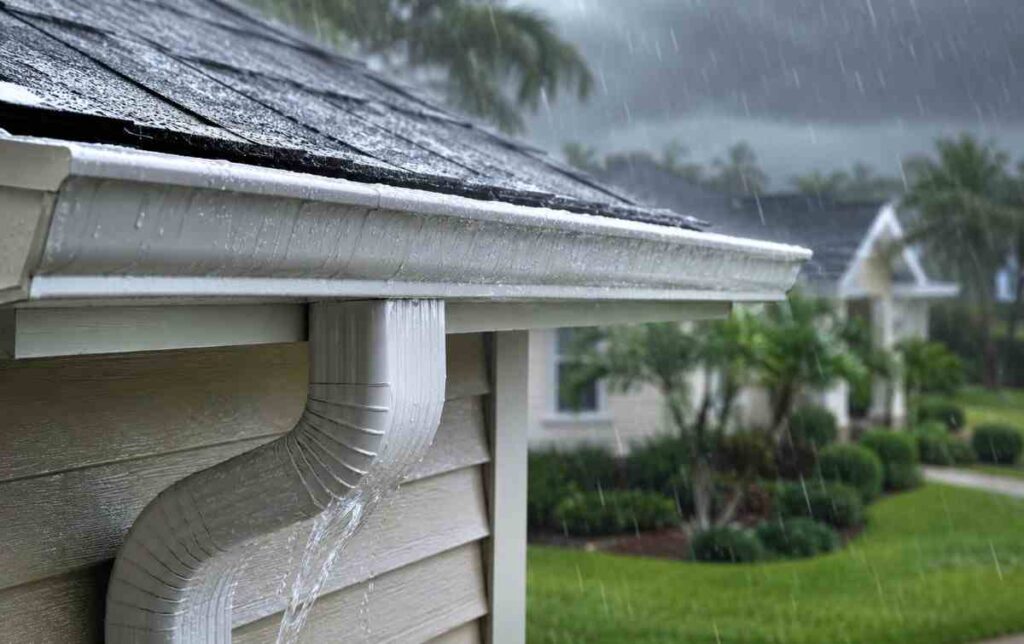
Do I Need Bigger Gutters for Heavy Florida Rain?
Yes, many Florida homes can benefit from larger gutters when they experience heavy rainfall, but gutter size alone does not determine whether a system will handle Florida storms effectively. Roof size, roof pitch, gutter length, downspout capacity, drainage layout, and local rainfall intensity all matter. For homes exposed to frequent heavy downpours, a properly designed 6-inch gutter system with adequately sized downspouts can provide more water-handling capacity than traditional 5-inch gutters. Florida’s intense rain can quickly overwhelm an undersized or poorly designed gutter system. If water regularly spills over the edges, pools around the foundation, or pours from the roof during storms, it may be time to evaluate your gutter size and overall drainage system. Why Does Florida Need Larger Gutters? Florida receives frequent heavy rainfall, particularly during the summer storm season and tropical weather events. A roof can collect and concentrate a surprisingly large volume of water during a short, intense downpour. Your gutter system must collect that runoff and move it efficiently into downspouts. If the gutters or downspouts cannot handle the incoming water, the system may overflow even when the gutters are clean. Common problems caused by inadequate gutter capacity include: Water overflowing over the front or back of gutters Erosion around the foundation Soil washing away from landscaping Water collecting near exterior walls Staining on siding and exterior surfaces Crawl-space or basement moisture Damaged landscaping Premature gutter deterioration Foundation drainage problems Are 6-Inch Gutters Better for Heavy Florida Rain? For many Florida properties, 6-inch gutters are a practical upgrade when compared with traditional 5-inch residential gutters, particularly when the roof produces substantial runoff. WeatherTek states that it installs 6-inch gutters for residential and commercial applications and uses 3×4-inch downspouts to move larger amounts of water away from the property. The company also notes that 5-inch gutters can channel significantly less water than its 6-inch systems, making larger capacity especially useful in areas with frequent heavy downpours. However, gutter capacity should always be evaluated as a complete system. A large gutter connected to an undersized or clogged downspout can still overflow. If your gutters consistently struggle during storms, it is worth having the system professionally evaluated rather than simply replacing the existing gutters with a larger size. Homeowners comparing installation options can book gutter installers for a property-specific assessment. What Determines the Right Gutter Size? Several factors influence whether standard or oversized gutters are appropriate for a Florida home. 1. Roof Size A larger roof collects more rainwater. Even if rainfall lasts only a short time, a large roof can send a substantial amount of runoff toward the gutter system. Large homes, additions, garages, and buildings with multiple roof sections may require greater gutter capacity. 2. Roof Pitch Steeper roofs can cause rainwater to move toward gutters more rapidly. During intense rainfall, this can increase the amount of water entering the gutter at one time. A gutter system should therefore be evaluated according to both roof area and roof configuration. 3. Rainfall Intensity Florida does not simply experience long periods of ordinary rain. Sudden, intense downpours can produce large volumes of runoff in a short period. This is one reason homeowners in Jacksonville and other parts of Florida should consider gutter capacity when planning or replacing a rainwater drainage system. 4. Downspout Size and Quantity A gutter can only perform as well as its downspouts allow. If a gutter collects a large volume of water but the downspouts cannot discharge it quickly enough, water can back up and spill over the gutter edge. Larger or additional downspouts can improve drainage performance, depending on the property’s design. 5. Roof Valleys Roof valleys concentrate water from two roof sections into one location. These areas can experience much heavier water flow than a straight section of gutter. If you notice overflow repeatedly occurring below a roof valley, the problem may involve localized water volume rather than the size of the entire gutter system. 6. Gutter Slope and Installation Even correctly sized gutters can perform poorly if they are installed incorrectly. Gutters need appropriate pitch so water moves toward the downspouts rather than remaining stagnant inside the channel. Sagging, improperly positioned hangers, loose sections, or poor connections can restrict water flow and contribute to overflow. How Do I Know My Gutters Are Too Small? Your gutters may not have enough capacity if you regularly notice these warning signs during heavy rain: Water pours over the sides of the gutter. Water collects around the home’s foundation. Downspouts discharge slowly despite clean gutters. Water backs up near roof valleys. Gutter sections sag when filled with water. The ground below downspouts becomes heavily eroded. Water stains appear on exterior walls. Gutters overflow even after cleaning. Water runs down the side of the house during storms. One isolated overflow does not automatically mean your gutters are undersized. Leaves, pine needles, clogged downspouts, improper slope, damaged gutters, or poor drainage may produce similar symptoms. That is why identifying the cause of the overflow is more important than immediately choosing a larger gutter. Should I Upgrade From 5-Inch to 6-Inch Gutters? A 6-inch gutter upgrade may make sense when: Your roof produces substantial runoff. Your existing 5-inch gutters overflow frequently. Your property experiences intense rainfall. You have steep roof sections. Your roof contains large valleys. Your home has multiple roof sections draining into concentrated areas. Your current downspouts are inadequate. You are replacing an aging gutter system anyway. WeatherTek specifically recommends 6-inch gutters for residential and commercial applications in its service area and pairs them with 3×4-inch downspouts. The important point is that gutter size should be matched with downspout capacity and the property’s overall drainage plan. Do Bigger Gutters Solve Foundation Drainage Problems? Not necessarily. Larger gutters can collect and control more roof runoff, but that water still needs somewhere to go. If downspouts discharge directly beside the foundation, increasing gutter capacity may simply move more water to the same problem area. A complete rainwater drainage strategy may include: Properly sized gutters Adequate downspouts Downspout